No doubt you’re familiar with the old riddle, How many angels can dance on the head of a pin? My answer to this famous conundrum is that angels don’t dance on the head, they dance on the point.
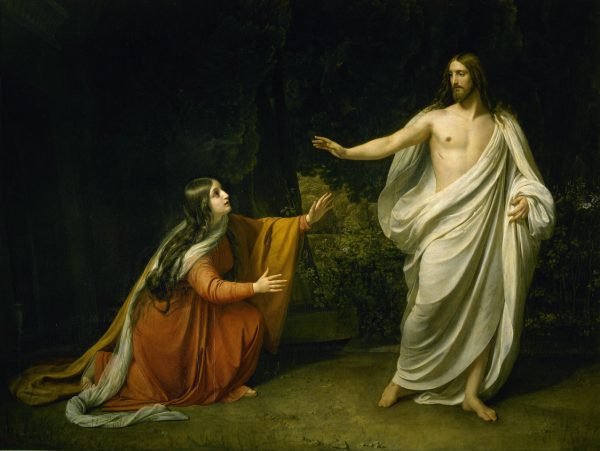
Christ’s Resurrection Appearance to Mary Magdalene, by Alexander Ivanov
Be that as it may, there’s another theological mystery just as compelling, which is the question of how many women named Mary are mentioned in the New Testament. No matter how you count, there’s a lot of them, and this, it seems to me, is one of the evidences of scripture’s authenticity. If I were inventing a story about Jesus, I wouldn’t have two disciples named James, two more named Judas, six characters named Simon, and several more named Mary. The very confusion among these identities lends historical veracity to the text.
So how many Mary’s are there? Estimates range from two to five, and in this article I’m arguing for three, a point of view that requires collapsing Mary Magdalene and Mary of Bethany (sister of Lazarus) into one single person. (The other Mary’s, incidentally, are Mary the mother of Jesus, Mary the mother of James and Joses, and Mary of Clopas, the last two of whom may also be the same person.)
The view I’m presenting has currently fallen out of favor, although for many centuries—right up until the twentieth—it was the standard opinion of the church and of nearly all the most respected biblical commentators. Maybe it’s time to dust off this traditional view and reconsider it.
When I first delved into this question, my intent was simply to prepare a Bible study for our small group. Normally when I lead a Bible study, I’ve already arrived at my own settled opinion of the passage, and I want to guide others into the surprising revelations that I myself have received. In this case of the Mary’s, however, the issue seemed so complex that I thought for once we might simply explore the relevant texts together. I wanted to find out what other people thought.
Before long, however, my mind was radically changed. It had never actually occurred to me that Mary Magdalene and Mary of Bethany might be the same person, nor had I ever encountered this theory elsewhere. Yet as I studied the gospels for myself, suddenly the likely truth of this idea jumped out at me, and was repeatedly confirmed the more I thought about it. I’m now sold on it one hundred percent, and I find it very inspiring, indeed exciting. It’s profoundly changed the way I think about some of the most precious stories in the four gospels, and has elevated Mary Magdalene into probably the most important of all the followers of Jesus throughout history. (Sorry Peter, Paul, Augustine, etc.)
After all, in the words of one commentator (Clement Harrold), if these two Mary’s truly are one, then “Mary Magdalene shines forth once more as the one who loved much (Luke 7:47), the one from whom seven demons were cast out (Luke 8:2), the one who grasped the “one thing necessary” (Luke 10:42), the one who moved the God-Man to tears (John 11:33–35), the one who did “a beautiful thing” for Him (Mark 14:6), the one whose deed would be proclaimed throughout the world (Mark 14:9), and the one who first saw the Risen Lord and believed (John 20:18)”—for which reason she is justly called “The Apostle to the Apostles.”
I hope by now you’re curious. However, since I’ve already used up my usual space for a blog post, I’m not going to expand on this subject, because I discovered someone else who has already presented the arguments much more cogently than I can. So I’ll simply refer you to thee article by Clement Harrold quoted above: “A Retrieval of the Traditional View of Mary Magdalene From the Fringes of Theology.” For my money, Harrold knocks this issue out of the park. And if you’re thirsty for more, as I was, you can look up the excellent book on which Harrold’s article is largely based: Saint Mary Magdalene: Prophetess of Eucharistic Love by Sean Davidson.
There—have I whetted your interest? The other thing you can do, of course, is to come to our Bible study when our group reconvenes in September. Consider yourself invited.
Next Post: Radical Amazement: New Quotes on Ordinary Life