I’ve been studying the Lord’s Prayer in the middle of the night. Not every night, but once or twice a week I find myself lying awake for a couple of hours, for no particular reason. Lately I’ve employed this time by reciting the Lord’s Prayer, very slowly, meditating on each phrase, until I fall back to sleep.
Last night it hit me how mindblowingly radical is this prayer. Take just the first couple of phrases: Our Father, who art in heaven, hallowed be Thy name.
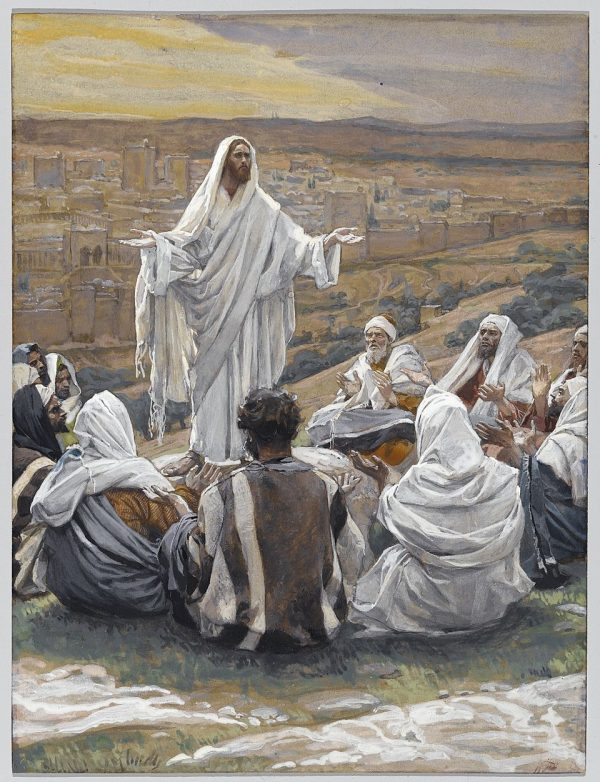
The Lord’s Prayer by James Tissot
Right off the bat, the word Father launches a revolution. The fact that God is “our Father” is the central revelation of the New Testament, the single idea that most distinguishes the New Testament teachings from those of any other religion. In the words of J.I. Packer in his book Knowing God, “What is a Christian? The question can be answered in many ways, but the richest answer I know is that a Christian is one who has God as Father. Father is the Christian name for God.”
This revelation of God as Father is one that could only have come through the Son, through God Himself incarnate in Jesus Christ, author of the Lord’s Prayer.
Nor is Father even the best word for this staggering depth of paternal intimacy. Closer to the mark would be something like Papa, Daddy, or Dada. In Aramaic (the language of Jesus) the word is Abba, a term of deep familial affection. Jesus addresses God this way in the Garden of Gethsemane: “Abba, Father, all things are possible for You” (Mark 14:36). And Paul explains that all believers in Christ are God’s children, by whom we cry, “Abba, Father” (Rom 8:15-6).
So far so good. You probably know all this. But imagine how this opening must have perplexed and embarrassed the disciples who first heard it. And the real shocker comes in the next phrase, “Hallowed be Thy name.”
What??!! We’re just getting used to calling God Daddy, only to be reminded that He’s holy and we mustn’t get too chummy. Hmm. It’s as if your priest or minister said to you, “Call me Fred,” then immediately added, “But make sure you preface it with the title Most Reverend.”
Most Reverend Fred. What’s going on here? Does this God want to be close to us, or not?
Do you see how the whole of the Old and New Testaments is summed up in these first two lines of the Lord’s Prayer? Yes, everything has changed and God is now our Daddy. But no, actually nothing has changed, because He’s still holier than thou.
Does this mean we are to retain a sense of reverent distance from our loving Papa, aware of His affection for us but keeping Him at arm’s length? No, it means exactly the opposite. It means that the very concept of religion (a word that means joining) has been reframed as no longer an arm’s length reverence, but rather a warm embrace, indeed a cosmic bear hug from our adoring heavenly Dad.
And why is He willing to embrace us? Because now, in Christ, we too are holy. Because look at the next shocker: Thy kingdom come. While the Lord’s Prayer begins with our divine Parent up in heaven, it quickly calls upon this same celestial Lover to invade the earth with His extravagant intimacy. In three short lines heaven and earth have been married.
The Lord’s Prayer isn’t just a nice liturgical formula. It’s Jesus telling us what He and His gospel are all about.
Next Post: The Answer to All Questions: SPLAT!