In a world that grows increasingly dark and chaotic, I wonder if any topic in theology is of greater significance than that of the sovereignty of God? What a comfort to our minds and hearts if we could actually trust Him to be in absolute control of everything.
On the contrary, if we cannot trust in God’s almighty power and goodness, how that pulls the rug from under the whole elaborate structure of our so-called faith.
Ah, yes—but what about free will, that notorious and muscular opponent of divine sovereignty? How to reconcile these three apparently irreconcilable options?
Wait—did I say three? Yes, that magic numero tres. Because there exists another candidate in this theological sack race, one scarcely considered. And that is the possibility of an intermediate solution, one that partakes of both sovereignty and free will yet which stands gloriously alone. However, this is an option that comes to light only if we take the radical step of allowing scripture to speak for itself.
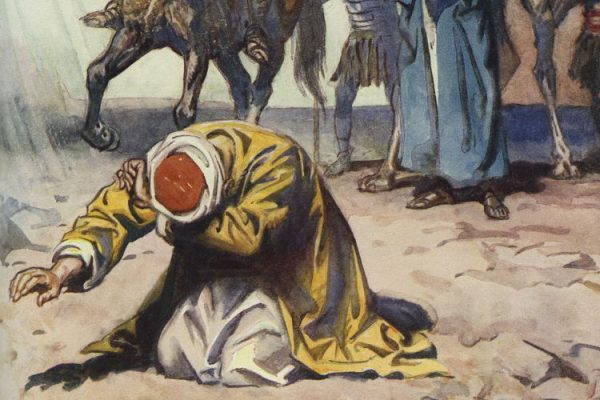
Paul on the Damascus Road, by H.M. Brock
Take the case of Paul, violently waylaid on the road to Damascus, blinded, and given a whole new set of marching orders for his life. Did this man have free will? Yes, but he threw it away when he met Jesus Christ and became His bond slave. As he later said, “I consider everything a loss before the surpassing worth of knowing Christ Jesus my Lord” (Php 3:8). And he went even further, saying, “I live no longer, but Christ lives in me” (Gal 2:20).
Or consider Mary, going about her usual daily chores when suddenly confronted by an angel who tells her, in no uncertain terms, “You will conceive and give birth to a son, and you will call Him Jesus … The Holy Spirit will come upon you, and the power of the Most High will overshadow you” (Lk 1:31-5). Notice the stong verb ‘will,’ repeated four times in this pronouncement. Much has been made of Mary’s great ‘yes,’ her courteous assent to the divine plan. But the fact is, she is given no choice in the matter. This is no invitation, but a fiat. Whether Mary likes it or not, this is the Lord’s sovereign will and it will happen. That is what scripture says.
Does this not throw the kibosh into that cherished old notion that God is always a gentleman and will never force His way into anyone’s life? Yes, it does. In truth, God does occasionally—and perhaps more often than we think—override our free will with His divine fiat.
So did Mary really have free will? Yes, but like Paul, she laid it at the feet of her divine master: “I am the Lord’s servant. May it be to me as you have said” (v 38).
Here is the resolution of the age-old tug-of-war between sovereignty and free will: total human submission. As the priest Eli put it, “He is the Lord—let Him do whatever He likes” (1 Sam 3:18). Or as the Lord Himself prayed, and told us to pray, “Not my will, but Thine be done.” Meanwhile most of the world is praying the opposite: “Not Thy will, but mine be done.” For notice the corollary: Just as God’s sovereignty can overrule human will, so does He allow for the reverse to happen, as it most commonly does.
Is God still sovereign, then, over the world’s ugly mess? Well, guess who hovered over the darkness of chaos in the very beginning and said, even before there was a sun, “Let there be light!”
In summary, Adam and Eve seized hold of free will as their prerogative, but in Christ our free will is surrendered. What would have happened if Paul and Mary had not abandoned their will to God’s sovereignty? Scripture is full of answers to this question, from hard-hearted Pharaoh to nearly every king of Judah and Israel, and the results were not pretty.
In the end, this hot-button tug-of-war is no more complicated than simple mathematics. Two plus two equals four, and if we try to answer five we’re in big trouble. The proper use of free will is to surrender it wholeheartedly to God, and in this way—and only this way—we become truly free. For in truth, apart from Christ our ‘free will’ is not wholly free; like everything else that was good in us, it was corrupted in the fall. But “if the Son sets you free, you will be free indeed” (John 8:36). In the words of the Book of Common Prayer, “God’s service is perfect freedom.”
Next Post: Jesus’ Use of Figures of Speech